Noise is the most common complaint about exhaust fans — and the easiest to get wrong at the specification stage. This guide explains what the numbers mean and how to choose a fan that stays quiet in a bedroom or bathroom.
Quick answer: A fan in the 25–35 dB(A) range is very quiet for a bedroom; 35–45 dB(A) is noticeable but usually acceptable in a bathroom; and 45–60 dB(A) is clearly audible. Installation matters as much as the headline rating, so size the system using the airflow calculation guide and check duct resistance, measurement distance and mounting.
How Fan Noise Is Measured
Fan noise is usually quoted in dB(A) (decibels, A-weighted to match human hearing) or, in North America, in sones. A change of about 10 dB is perceived as roughly a doubling or halving of loudness. As a practical rule:
| Noise level | Perception | Typical fan |
|---|---|---|
| 25–35 dB(A) | Very quiet — suitable for bedrooms | Silent series, EC mixed-flow inline |
| 35–45 dB(A) | Noticeable but acceptable in bathrooms | Standard ceiling / mixed-flow inline |
| 45–60 dB(A) | Clearly audible — kitchens, utility rooms | Axial wall / window fans |
What Makes a Fan Quiet
- Impeller design: mixed-flow impellers are inherently lower-turbulence than axial propellers.
- Motor type: EC (electronically commutated) motors run quieter and cooler than basic AC motors.
- Mounting: an inline fan inside a duct is quieter than an exposed wall fan — the duct absorbs sound.
- Duct match: an undersized duct adds airflow noise ("whistle") of its own.
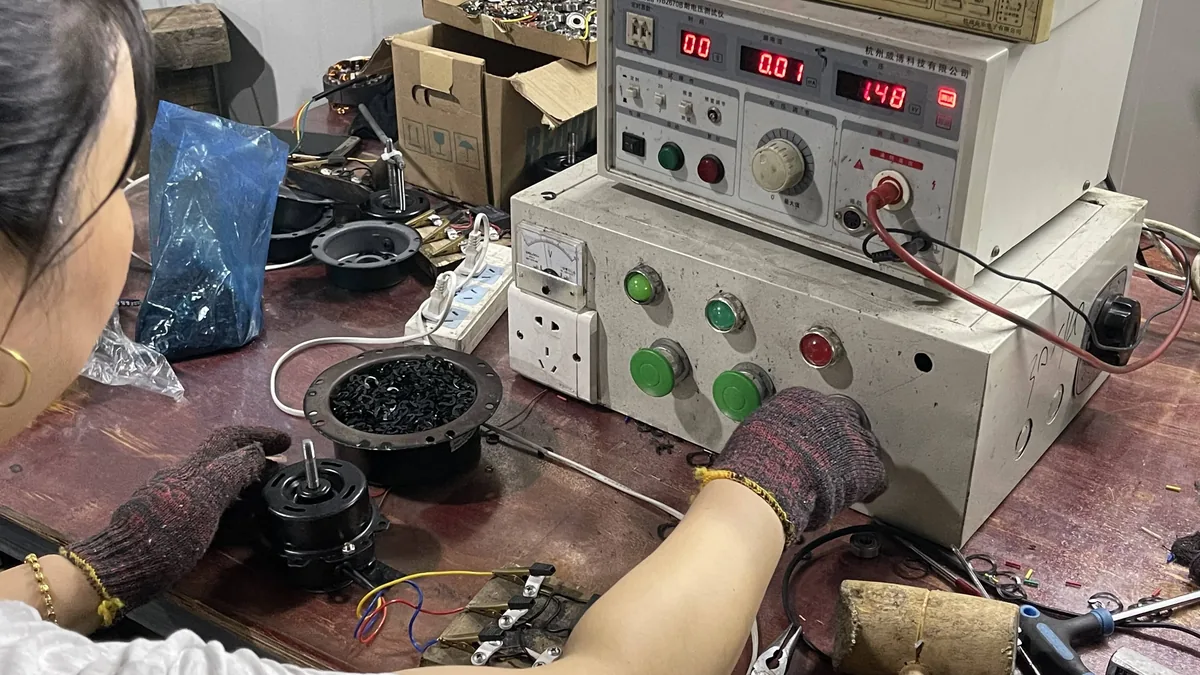
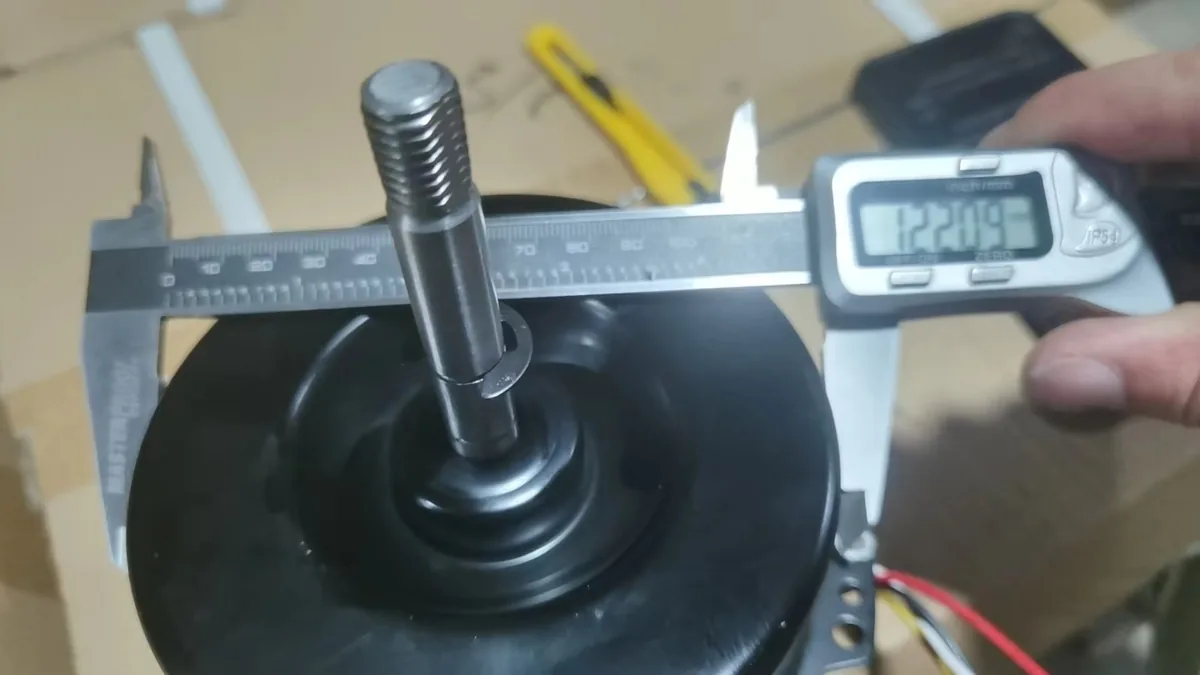
Beyond impeller and motor type, how a fan is built matters as much as how it is designed. Two checks from our own line in Shengzhou:
How to Keep a Fan Quiet
- Match the duct diameter to the fan outlet.
- Use rigid duct where possible; flexible duct adds turbulence and noise.
- Mount the fan on isolation to stop vibration transfer.
- Choose a silent-series or EC-motor model for bedrooms.
BAER publishes the measured noise rating for every model and can send the test report on request. See our silent bathroom fan for the quietest option.
Sones vs dB(A): Reading Both Scales
If you sell into North America you will meet sones. Unlike decibels, sones are linear: 2 sones is twice as loud as 1 sone, the way most people actually hear it. A whisper-quiet bathroom fan is around 0.3–0.5 sones; a standard builder-grade unit is 1.0–1.5; a powerful kitchen axial is 3–5.
What is a sone? A sone is a linear measure of perceived loudness. One sone is defined as 40 dB at 1 kHz — about the sound of a quiet refrigerator — and because the scale is linear, 2 sones sounds twice as loud as 1 sone. As a working conversion for datasheets, dB(A) ≈ 40 + 10 × log2(sones), which lands within a couple of dB of the table below. Sone ratings are a North American convention; European and Middle East submittals are quoted in dB(A).
Because sones double every ~10 dB, the scale below only needs a few anchor points — anything between them can be interpolated:
| Sones | Approx. dB(A) | What it sounds like | Typical application |
|---|---|---|---|
| 0.25 | ~25 dB | Barely audible | Premium silent series, bedroom en-suite |
| 0.5 | ~32 dB | Soft background hum | Quiet bathroom, hotel guest room |
| 0.75 | ~36 dB | Soft, noticeable only in a silent room | Small en-suite, hotel bathroom |
| 1.0 | ~40 dB | Clearly present, not intrusive | Standard residential bathroom |
| 1.5 | ~44 dB | Clearly audible | Family bathroom, small kitchen |
| 2.0 | ~48 dB | Obvious, conversation slightly raised | Kitchen, utility room |
| 3.0 | ~53 dB | Loud, a raised voice is needed | Utility room, small workshop |
| 4.0 | ~58 dB | Loud, short-duration use only | Commercial kitchen, workshop extract |
| 5.0 | ~61 dB | Very loud | Industrial extract, large kitchen hood |
| 6.0 | ~63 dB | Very loud, hard to talk over | Heavy-duty wall or roof extract |
| 8.0 | ~67 dB | Uncomfortable for long periods | Plant room, process extract |
BAER quotes dB(A) as standard and can provide the sone equivalent for North American submittals — ask at quote stage.
Noise Targets by Room Type
When a client asks "how quiet does it need to be?", this is the table to work from. These are measured at 3 m in a normally furnished room:
| Application | Target dB(A) | Max sones | Notes |
|---|---|---|---|
| Bedroom / en-suite, night use | 25–30 | 0.3–0.5 | Continuous trickle operation — anything above 35 dB keeps light sleepers awake |
| Family bathroom | 30–38 | 0.5–1.0 | Intermittent use, boosted on humidity sensor |
| Hotel guest bathroom | 28–35 | 0.4–0.8 | Guest expectation is the binding constraint, not code |
| Kitchen (domestic) | 40–48 | 1.5–2.5 | Acceptable because use is short and the room is already noisy |
| Office / meeting room | 30–35 | 0.5–0.8 | Speech intelligibility matters; NC-30 is a common spec |
| Commercial kitchen / workshop | 55–65 | 4.0+ | Occupational noise limits apply above 80 dB; hearing protection at 85 dB |
Note the commercial kitchen row: above 80 dB(A) most jurisdictions require hearing protection and noise monitoring. A specification that ignores this can create a compliance problem for the end client, which is worth raising early in a tender.
How to Read a Noise Figure on a Datasheet
This is where most specification mistakes happen. A fan's published dB(A) is often measured under conditions that flatter it, and two fans quoted at the same number can sound completely different once installed. Three things to check:
- Measurement distance. 3 m is the convention; 1 m figures look 8–10 dB worse for the same fan. Always confirm which was used.
- Free-air vs in-duct. Some suppliers quote the motor's free-air noise with no duct attached and no back pressure. Add a real duct run and 50–100 Pa of system resistance and that figure typically rises 5–10 dB.
- Airflow at which it was measured. Noise rises steeply with speed — a fan rated 32 dB at 200 m³/h may be 45 dB at its maximum 400 m³/h. The honest datasheet states the airflow alongside the noise figure.
BAER measures at 3 m with the fan mounted in a representative duct run at its rated duty point, and we state the airflow that applies. If a competing quote looks implausibly quiet, ask for the measurement conditions — the answer usually explains the gap.
Diagnosing a Noisy Fan After Installation
When a client reports a noisy fan, the fault is usually installation, not the product. Three symptom types cover almost everything:
| Symptom | Likely cause | Fix |
|---|---|---|
| Low hum or buzz that travels through the ceiling | Structure-borne vibration; fan screwed directly to joist or plasterboard | Add rubber isolation mounts or hang the fan on a bracket; never rigid-fix to a joist |
| High-pitched whistle | Air velocity too high — undersized duct, crushed flexible duct, or a restrictive grille | Increase duct diameter to match the outlet; replace crushed flex with rigid; use a free-area grille at least equal to duct area |
| Rattle or knocking that comes and goes | Loose screw, backdraught shutter flapping, or debris in the impeller | Tighten fixings; check shutter free movement; clear the impeller |
| Noise much louder than the datasheet | Fan working far up its curve against excessive static pressure | Re-measure static pressure; reduce duct length or bends, or move to an inline mixed-flow fan with more pressure capability |
A rough field check: if the fan sounds right at the grille but loud elsewhere in the room, the problem is vibration. If it is loud at the grille itself, the problem is air velocity.
Where noise is a specification driver, mounting type matters as much as the fan itself: a wall fan sits inside the room and transmits vibration into the wall, while a ceiling or inline installation puts the motor above the ceiling line. Our wall vs ceiling exhaust fan guide covers this room by room.
Frequently asked questions
What are sones in an exhaust fan? +
What is a quiet exhaust fan in dB? +
How many sones is quiet for a bathroom fan? +
Why is my new fan noisier than the datasheet says? +
Does a bigger fan make less noise? +
Are inline duct fans quieter than wall fans? +
Need a factory-direct quote?
Send your application, quantity and destination — our export team replies within one working day.
Request a Quote