If you are weighing a wall vs ceiling exhaust fan, here is the short answer: a wall fan wins whenever the room sits on an outside wall — it vents straight outdoors with almost no duct loss and costs a fraction to install. A ceiling fan wins for internal rooms and anywhere quiet operation matters. Below is why, with the airflow and cost numbers behind each choice.
Wall-mounted and ceiling-mounted exhaust fans both extract air, but they suit different rooms and different construction. This guide lays out the trade-offs — written from the factory side, based on the specifications we ship to contractors in the Gulf, Europe and North America.
Quick decision: Use a wall-mounted fan for a direct outside-wall route and low duct resistance. Use a ceiling-mounted or inline fan when the room is internal, the finish should be concealed, or the installation needs quieter ducted extraction. For the airflow calculation behind the choice, see BAER's exhaust fan airflow sizing guide.
Wall vs Ceiling Exhaust Fan: The 30-Second Decision
Answer these three questions in order and the choice is usually made:
- Does the room have an outside wall? Yes → wall fan. No → ceiling fan (or an inline duct fan).
- Will the air travel through more than 3 m of duct or two 90° bends? Yes → size up one class, or move the fan into the duct run as an inline unit.
- Is the room a bedroom, hotel bathroom or meeting space? Yes → ceiling or inline, and specify under 35 dB(A).
The most common specification error we see: ordering a ceiling fan at its free-air rating for a long duct run. On a 5 m run with two elbows, a 250 m³/h axial fan can deliver under 150 m³/h at the grille. Always specify airflow at static pressure — the difference is the difference between a bathroom that clears in four minutes and one that never dries.
The Difference at a Glance
| Factor | Wall-mounted fan | Ceiling-mounted fan |
|---|---|---|
| Where it vents | Directly through an outside wall | Through the ceiling and a duct to the outside |
| Best for | Kitchens, workshops, rooms on an outside wall | Bathrooms, internal rooms without an outside wall |
| Installation | Simple — one hole in the wall | More involved — duct run required |
| Noise | Exposed, usually louder | Can be quieter (especially inline) |
| Cost | Lower | Higher (fan + duct + labour) |
When to Choose a Wall Fan
- The room has a direct outside wall and no ducting is possible.
- You need high airflow at low cost (kitchens, workshops, warehouses).
When to Choose a Ceiling Fan
- The room is internal, or you want a flush, concealed finish.
- You need quiet operation in a bathroom or bedroom.
How Mounting Position Affects Airflow (CFM)
Mounting type changes more than appearance — it changes how much actual airflow you get. A wall fan pushes air straight through a short opening, so nearly all of its rated CFM reaches the room. A ceiling fan loses performance with every metre of duct and every 90° bend: a typical 100 mm duct run with two elbows can cut real airflow by 30–50% compared with the free-air figure on the box.
The table below is what we work from when a contractor sends us a duct layout. It shows the real delivered airflow of the same 250 m³/h fan in different mounting situations:
| Mounting situation | Typical static pressure | Real delivered airflow | Loss vs rating |
|---|---|---|---|
| Wall-mounted, straight through wall + shutter | 10–20 Pa | 235–245 m³/h | 2–6% |
| Ceiling, 1.5 m duct, one grille | 40–60 Pa | 205–225 m³/h | 10–18% |
| Ceiling, 3 m duct, two 90° bends | 80–110 Pa | 165–195 m³/h | 22–34% |
| Ceiling, 5 m+ duct, three bends, roof cowl | 130–180 Pa | 120–160 m³/h | 36–52% |
| Inline mixed-flow in the duct run (same layout) | 130–180 Pa | 230–250 m³/h | 0–8% |
Figures are typical for a 100–150 mm axial fan of 250 m³/h free-air rating; always confirm against the model's published pressure curve.
The practical rule: if the installation needs more than 3 metres of duct or two bends, step up one fan size — or specify an inline mixed-flow fan, which is engineered to maintain pressure over long duct runs. Before you buy, size the room properly with our fan CFM calculator, then match the result to the fan's rated pressure performance rather than its free-air number.
Installation: What Each Type Actually Requires
Wall-mounted fan
- One core-drilled or brick-cut opening through an exterior wall (typically 100–150 mm).
- An external wall sleeve or frame, plus gravity shutters on the outside face to block back-draughts, rain and pests.
- Electrical connection and weather sealing — usually a 1–2 hour job per unit.
Ceiling-mounted fan
- A ceiling cut-out plus a duct run to a wall or roof outlet — every metre adds cost and pressure loss.
- Roof or wall cowl to terminate the duct safely outdoors.
- More labour: ceiling access, duct fixing and coordination with other trades are typical on site.
For importers and contractors, this difference matters at project scale: wall fans mean cheaper, faster installation across dozens of rooms, while ceiling/inline systems are specified where aesthetics and acoustics justify the extra cost.
The Same Airflow, Three Ways: Noise and Power From Our Own Catalogue
The comparison above is about physics. This one is about the three product ranges we actually build, placed side by side at the same duty point, because this is where the mounting decision changes the invoice as well as the comfort.
| Airflow you need | Wall / window axial KLT panel series | Ceiling mount 100 / 150 / 200 mm | Inline ducted BXF mixed-flow |
|---|---|---|---|
| Around 150 m³/h | KLT-10B — 150 m³/h, 35 dB, 30 W | Inside the 80–350 m³/h range, ≤26 dB(A), 8–25 W | BXF-100 — 290 m³/h at 150 Pa, 28–31 dB(A), 48 W |
| Around 400 m³/h | KLT-12B — 380 m³/h, 38 dB, 30 W; KLT-18B — 432 m³/h, 42 dB, 40 W | Inside the range, ≤26 dB(A), 8–25 W | BXF-125 — 420 m³/h at 180 Pa, 28–31 dB(A), 50 W |
| Around 800 m³/h | KLT-20B — 792 m³/h, 45 dB, 80 W | At the top of the range (350 m³/h) — this duty is beyond it | BXF-150 — 620 m³/h at 300 Pa, 28–32 dB(A), 60 W |
| 1,500 m³/h and up | KLT-25B — 1,500 m³/h, 48 dB, 120 W; KLT-30B — 1,800 m³/h, 48 dB, 120 W | — | BXF-200 — 1,200 m³/h at 380 Pa, 45–50 dB(A), 120 W; BXF-250 — 1,800 m³/h at 488 Pa, 200 W |
Figures are catalogue values for each model. The ceiling range is quoted as one series (80–350 m³/h, ≤26 dB(A), 8–25 W over three spigot sizes) because the airflow is set by which size you fit, not published per size. Inline figures are quoted at the static pressure shown, not free air.
What the noise column actually means
At roughly 150 m³/h, the wall fan is rated 35 dB and the ceiling fan ≤26 dB(A). Nine decibels does not sound like much on paper. On the ear it is close to twice the loudness, because a 10 dB rise is heard as roughly double. In a bathroom next to a bedroom, that is the difference between a fan you notice and one you forget.
The wall fan still wins on two counts: it delivers its airflow with almost no duct loss, and it costs less to install because there is no duct run to buy or chase into the ceiling. If the room has an outside wall and the fan is in a workshop, corridor or kitchen, noise is rarely the deciding factor.
The 350 m³/h ceiling limit is real
Our ceiling range stops at 350 m³/h. Above that, a ceiling installation is no longer a ceiling fan — it is an inline unit in the duct above it. That is not a gap in the range, it is the point at which the duct itself has to carry the air, and an axial impeller in a ceiling grille stops being able to do it. On those jobs the choice is between a large wall fan and a BXF inline, and the duct-loss table earlier on this page tells you which one holds its figure.
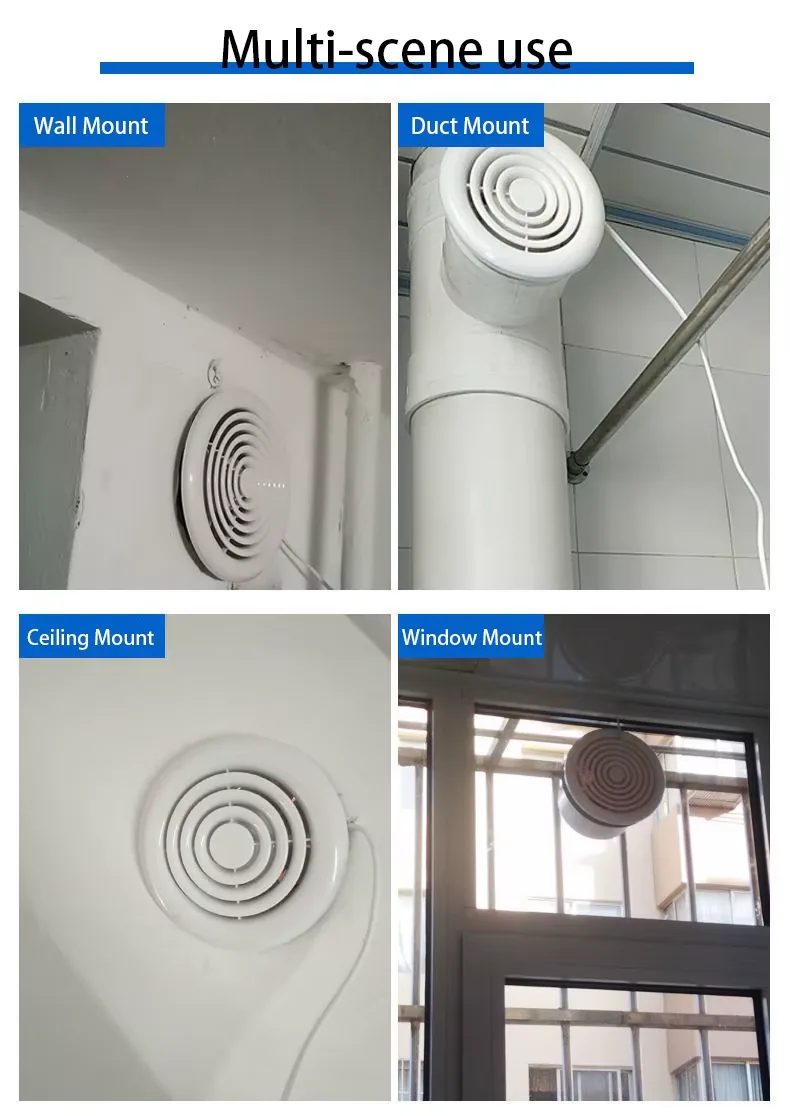
Quick Recommendations by Room
| Room | Recommended type | Why |
|---|---|---|
| Bathroom (internal) | Ceiling + inline duct fan | No outside wall; quiet, ducted extraction to the roof |
| Bathroom (external wall) | Wall fan or window fan | Shortest air path, lowest cost |
| Kitchen | Wall-mounted (wall/window fan) | Grease-laden air should exit directly, not through ducts |
| Bedroom | Ceiling fan, low-noise model | Concealed installation, minimal noise (target <35 dB) |
| Workshop / warehouse | Large wall fan | Maximum airflow per dollar, no duct losses |
| Commercial toilets | Ceiling + inline system | Multiple inlet points served by one ducted fan |
Special Considerations for Hot and Dusty Climates
In Middle East conditions — fine dust, coastal humidity and summer temperatures above 45°C — mounting choice has long-term consequences. Wall-mounted units face the weather directly, so they need gravity shutters or butterfly dampers to keep dust and hot air from back-flowing when the fan is off, plus UV-stable external grilles. Ceiling/inline systems keep the fan mechanism indoors where it stays cleaner and cooler, which usually extends service life; the trade-off is that ducts passing through unconditioned roof spaces should be insulated to avoid heat gain.
We cover the full specification checklist — protection classes, shutter types and voltage options — in our guide to exhaust fans for the Middle East climate.
Frequently Asked Questions
Which is better, a wall or ceiling exhaust fan?
Neither is universally better — match the type to the construction. If the room has an outside wall, a wall fan is cheaper and delivers more of its rated airflow. If the room is internal, or quietness matters, a ceiling fan with a short duct run (or an inline fan) is the right choice.
Can I install a wall fan in an internal bathroom?
No. A wall fan must vent directly through an outside wall. For internal bathrooms, use a ceiling fan connected to ducting that terminates outside — an inline mixed-flow fan is the usual choice because it maintains airflow over the duct run.
Is a ceiling exhaust fan more expensive to install?
Yes, typically. Between the ceiling cut-out, the duct run, the external cowl and the extra labour, a ceiling installation costs several times a wall installation. What you gain is quieter operation and a concealed finish.
Do wall exhaust fans need shutters?
Strongly recommended. Gravity shutters close when the fan stops, blocking rain, dust, insects and hot outside air — essential in dusty or coastal climates. Most quality wall fans include an integrated shutter; check before ordering.
What size fan do I need for each type?
Size by room volume and air changes per hour, not by duct size alone. Because ceiling installations lose airflow through ducts, size up when the duct run is long. Our CFM calculator gives you the target airflow in under a minute.
Which is quieter, a wall or ceiling exhaust fan?
A ceiling installation is usually quieter, for two reasons: the fan sits above the ceiling line so sound is attenuated by the ceiling material, and ceiling/inline models are typically specified with lower-noise motors and housings. A wall fan is mounted in the same room and transmits structure-borne noise directly into the wall. For bedrooms and hotel bathrooms, target under 35 dB(A) — see our exhaust fan noise level guide for room-by-room targets.
Can I replace a wall exhaust fan with a ceiling fan?
Yes, but it is a construction job rather than a swap. The wall opening has to be sealed and made good, a ceiling cut-out created, and a duct run installed to an external wall or roof outlet with a weatherproof cowl. On tiled or finished bathrooms this often costs more than the fan itself, which is why the decision is best made at design stage rather than after handover.
For ceiling installs with any duct run, choose an inline mixed-flow fan so the airflow survives the duct. Browse our ceiling-mount and wall/window ranges for models.
Need a factory-direct quote?
Send your application, quantity and destination — our export team replies within one working day.
Request a Quote