The single most common bathroom fan mistake is buying by floor area instead of airflow. This guide gives you the number you actually need, and the quick way to get there.
Quick answer: Start with room volume, use 8 air changes per hour, divide by 60 to get CFM, then add 10–20% for duct resistance. A small 5 m² bathroom needs about 60 CFM / 100 m³/h; a large 12 m² bathroom needs about 140 CFM / 240 m³/h. For the wider sizing method, see the exhaust fan airflow calculation guide.
The Rule: 8 Air Changes per Hour
A bathroom should replace its full volume of air about 8 times per hour. The formula is:
CFM = (Length × Width × Height) × 8 ÷ 60
Or use the CFM calculator to get it instantly.
CFM by Bathroom Size
| Bathroom size | Volume (approx.) | Minimum CFM |
|---|---|---|
| Small (5 m²) | 12 m³ | ~60 CFM / 100 m³/h |
| Medium (8 m²) | 20 m³ | ~95 CFM / 160 m³/h |
| Large (12 m²) | 30 m³ | ~140 CFM / 240 m³/h |
Add Margin for the Duct
Every bend, grille and metre of duct reduces real-world airflow. Add 10–20% to the calculated CFM if the fan ducts to the outside through a ceiling run, and choose an inline mixed-flow fan rather than a wall axial fan for ducted installs.
Worked Example: A Real Bathroom, Step by Step
Take a typical family bathroom, 2.4 m long × 1.8 m wide × 2.4 m ceiling:
- Step 1 — Volume: 2.4 × 1.8 × 2.4 = 10.4 m³.
- Step 2 — Airflow: 10.4 m³ × 8 air changes ÷ 60 min = ~1.4 m³/min ≈ 50 CFM (83 m³/h).
- Step 3 — Duct margin: ceiling install with one bend → add 15% → specify a 60 CFM (100 m³/h) fan.
That's it — three lines of arithmetic, or thirty seconds in the online calculator. If your bathroom has no windows or includes a shower used several times a day, round up to the next standard size rather than down.
What Happens When the Fan Is Undersized
An under-spec'd bathroom fan doesn't just smell worse — it slowly damages the building:
- Mould and mildew on grout, ceiling corners and behind sealant within weeks of daily showers.
- Peeling paint and swollen door frames as relative humidity stays above 70% for hours after each shower.
- Condensation on mirrors and windows that takes 30+ minutes to clear — the visible symptom buyers actually complain about.
For hotels, apartments and student housing, this is a maintenance cost issue as much as a comfort one, which is why project tenders usually specify minimum extraction rates per bathroom rather than "a fan".
Noise: The Spec Buyers Forget to Check
CFM is only half the spec. A bathroom fan runs in a small room with hard surfaces, so anything above 40 dB will be intrusive. Practical guidance:
- Master bedrooms with en-suite: aim for ≤ 33 dB (ultra-quiet ceiling or inline models).
- Family bathrooms: 33–38 dB is comfortable for daily use.
- Guest/secondary bathrooms used briefly: up to 42 dB is acceptable if airflow is strong.
Silent-series fans achieve low noise with larger impellers running at lower speed — moving the same air more quietly than small, fast impellers. Compare sound pressure levels (dB at 3 m) on the datasheet, not marketing labels.
Choosing the Mounting Type
- External wall bathroom: a wall or window-mounted axial fan vents directly outside — cheapest and most efficient path.
- Internal bathroom: ceiling fan with ducting, powered by an inline mixed-flow fan that keeps its airflow over the duct run.
- Multiple bathrooms in one project: a single inline fan serving several inlet valves simplifies maintenance to one serviceable unit.
The trade-offs between the two mounting families — cost, noise and duct losses — are compared in detail in our wall vs ceiling exhaust fan guide.
For scale, one line from our order book: a lighting contractor in Romania took 2,000 mixed-flow inline units for shopping-mall washrooms. Mall washrooms are internal rooms with long duct runs and several inlet valves per fan — precisely the case where the 8 ACH figure has to be calculated room by room and the duct margin added on top, rather than estimated from floor area.
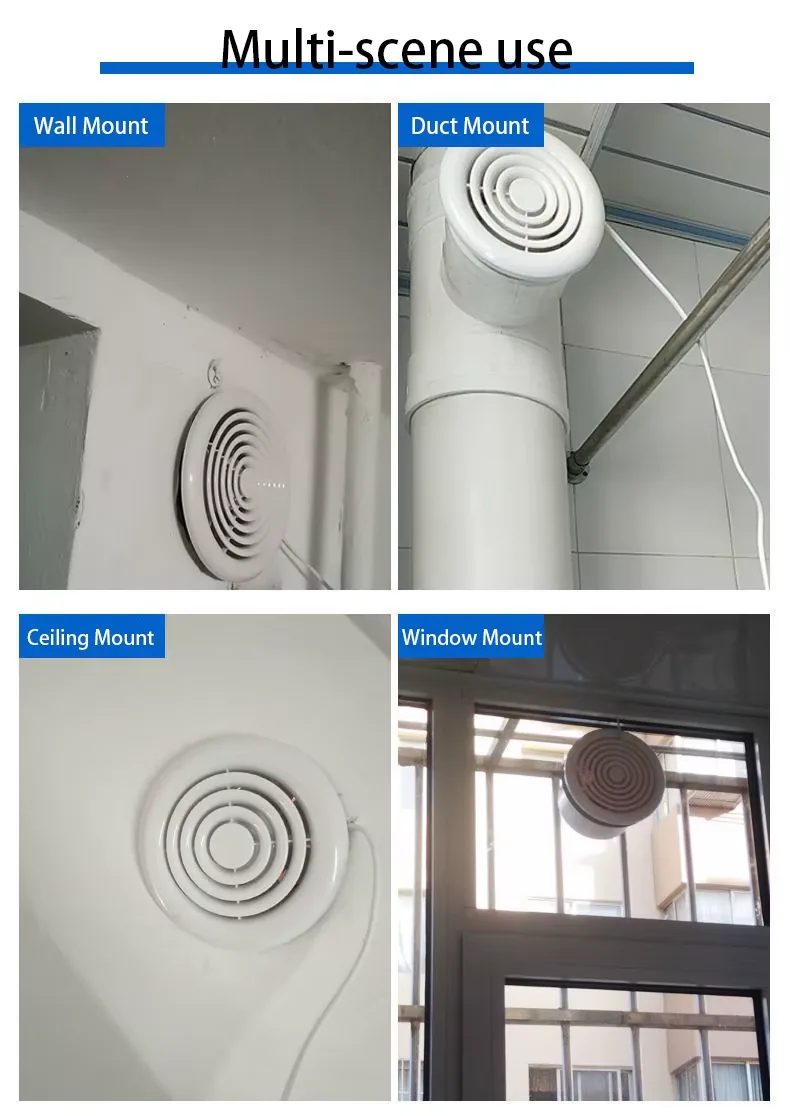
These are the four mounting situations the sizing rules above assume. Whichever you pick, the CFM target itself does not change — what changes is the margin you add for duct resistance.
Frequently Asked Questions
How many CFM does a bathroom exhaust fan need?
Rule of thumb: room volume × 8 air changes per hour ÷ 60. A small 5 m² bathroom needs about 60 CFM (100 m³/h); a large 12 m² bathroom about 140 CFM (240 m³/h). Add 10–20% for ducted ceiling installations.
Is 50 CFM enough for a bathroom?
Yes for a small bathroom (up to ~6 m² with standard 2.4 m ceilings) venting directly outside. For larger rooms or ducted installs, 50 CFM is usually too little once duct losses are counted — calculate the real number before buying.
How many air changes per hour does a bathroom need?
8 ACH is the accepted residential standard. Commercial changing rooms and humid climates often specify 10–12 ACH; luxury en-suites with steam showers should also be calculated at the higher rate.
Can a bathroom fan be too powerful?
Slightly oversized is safe; grossly oversized creates problems — it depressurises the room, pulls make-up air under the door from unconditioned spaces, and can back-draught water traps. Match the calculation and round to the nearest standard size, not three sizes up.
Do I need a window if I have an exhaust fan?
In most building codes, mechanical extraction replaces the ventilation window requirement provided the fan vents outdoors and achieves the minimum air change rate. Make-up air enters under the door or through a transfer grille.
Related Guides
- How to Calculate Exhaust Fan Airflow: CFM & m³/h Sizing Guide
- Panel Exhaust Fan Sizing Guide
- Panel Exhaust Fan Installation Guide
Need a factory-direct quote?
Send your application, quantity and destination — our export team replies within one working day.
Request a Quote